Not all print is created equal

There’s a perception in the literary world that getting published in print is the thing. The moment. You’ve made it! Your words on paper, bound and distributed, sitting on shelves somewhere in the world. And look, it is a moment for sure and it feels great. But here’s the reality: print is not a single category. The spectrum between one print publication and another can be so vast they might as well be different mediums entirely.
Several years ago a short story of mine was shortlisted for the Commonwealth Writers’ Prize. It was then picked up by an esteemed, internationally regarded, institutionally funded literary journal (the kind of publication that carries genuine prestige in the literary world). This is always an exciting moment for a writer. Knowing your work is going to be in print, and not just in print, but in a highly regarded journal with a long history and serious literary credentials. Whoop!
I waited months while my contributor copy made its slow journey to the bottom of the world. And I remember opening the package and holding it in my hands and feeling this deep sense of…well, not disappointment exactly, but realisation. The writing inside was wonderful. The journal was doing exactly what it set out to do: publish excellent literary work, affordably, at scale, backed by institutional funding. That’s a model that has sustained literary publishing for decades.
But it isn’t what we are doing with Folly.
Most literary journals are built to serve the writing. The physical object is a vehicle, it’s functional, affordable, designed to get the words into readers hands without burning through a budget that’s already stretched thin (because that’s one thing we all have in common in this industry - major budgetary constraints. This is art people!). There is absolutely nothing wrong with this and the literary eco system depends on them.
Folly however operates in a different niche entirely. We sit at the luxury- consumer end of the market, a space where very few literary publications are working because we are creating each issue with our end reader in mind. Rather than as a self congratulatory nod to the authors (although this also occurs - due to the success of Folly and their part in creating the art). Publications like Noon Annual in the US come to mind as a comparison- beautifully designed objects where the physical form is inseparable from the literary content. But Noon isn’t aimed at the average non literary (albeit intelligent) consumer reader.
Hence, we are in a tiny corner of publishing, and it’s not better or worse than the institutional model. It’s just different.
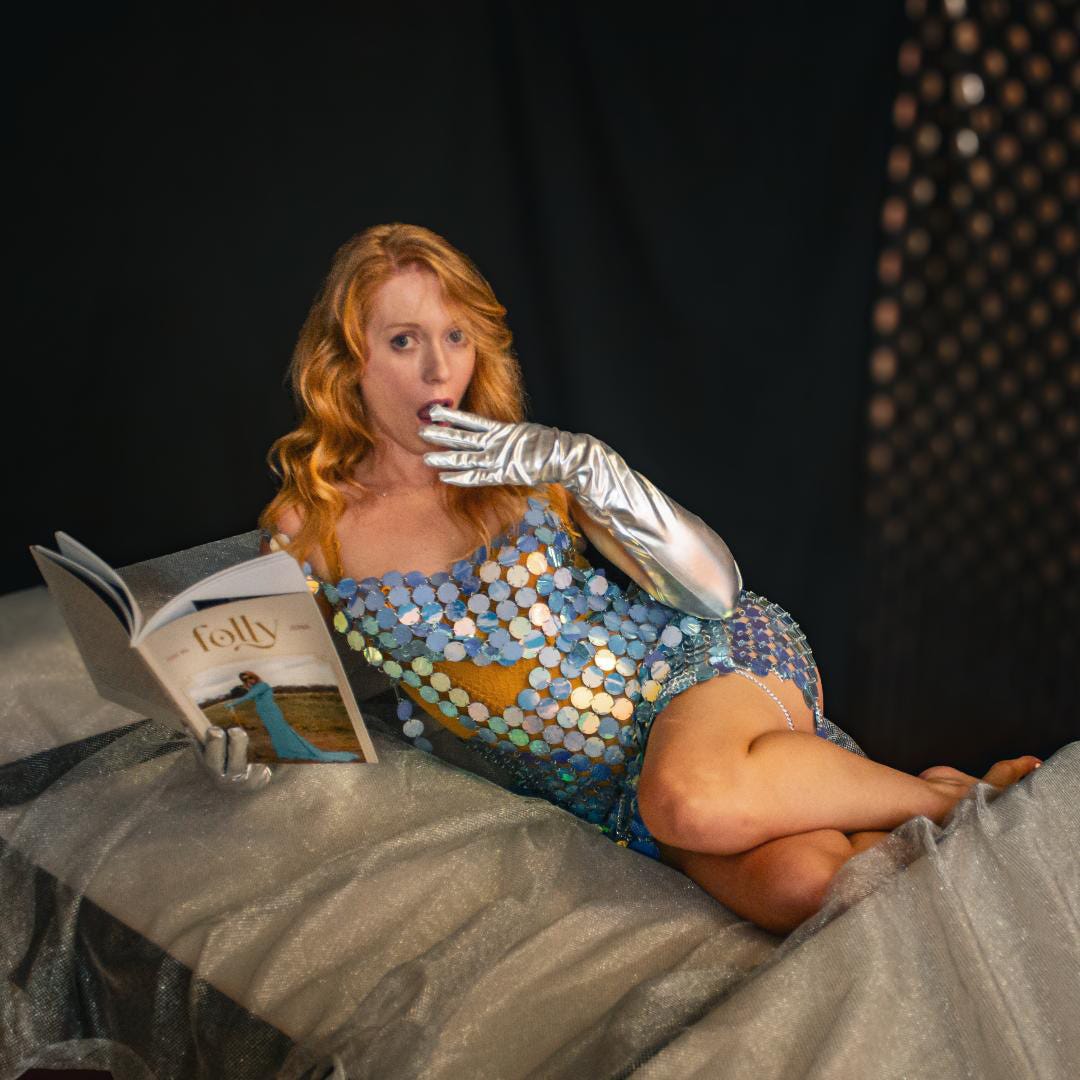
From Issue 001, we’ve treated the physical journal as a cultural artifact designed to take readers on a journey. The paper stock, the design, the weight of the thing in your hands. People display Folly on their coffee tables. They give it to friends for Christmas. They read it cover to cover at restaurants, alone, beside their dessert (we have proof!). They collect it.
And that moment, holding my contributor copy from this respected journal and then looking at what we had built with Folly, wasn’t about one being better than the other. It was about understanding, viscerally, what our niche actually is. We are creating a luxury consumer driven product in a space that doesn’t traditionally think in those terms.
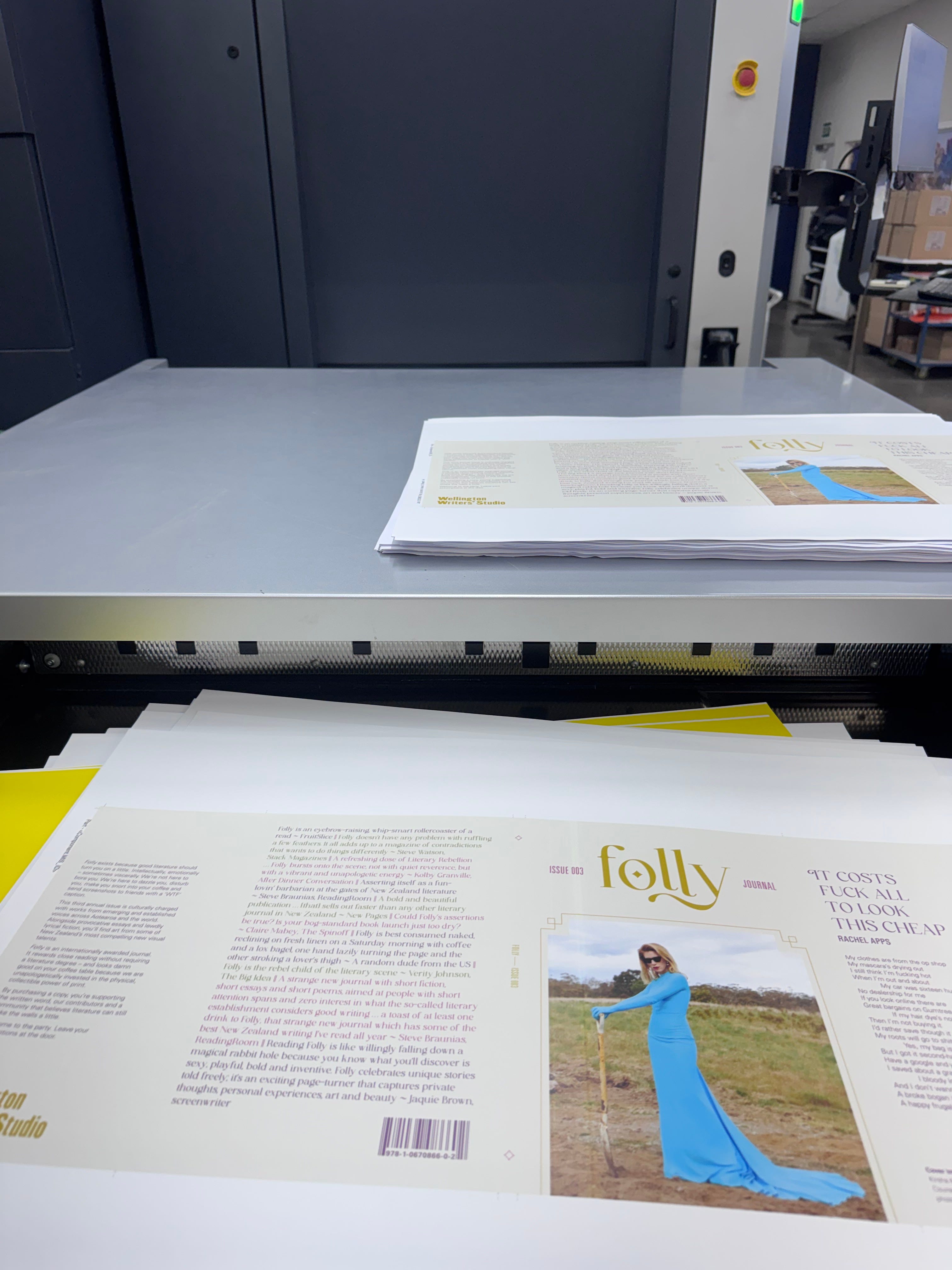
We are heading into production for Issue 004, and every year the curation of Folly becomes more refined as more people figure out what we’re actually doing. Our community is growing. Contributors are finding us from all over the world, sending work that is braver, stranger, more alive than anything we’ve received before. Yesterday I was sitting in an airport lounge reading erotica submissions (much of it written by men) we are also creating a Folly Erotica offshoot.
Yes, there is a commercial angle — we need to sell this in order to keep funding it. We’re not institutionally funded. We don’t have the luxury of an annual locked-in budget from a university. *Folly* runs on personal philanthropy (I pour a significant amount of my own earnings into keeping it alive), on sales, and on a small but growing subscriber base through Press Patron. Every issue that sells out funds the next one.
Who knows what will survive the internet. What is the point of creating extraordinary writing if it vanishes into pixels, or is printed in a disposable way? Equally, there’s no point creating a beautiful object if the writing inside doesn’t earn its place.
Issue 004 is coming. We want you to be part of it. We want writers who understand this ethos — that the writing and the vessel are the art form.
Submissions are open. Come find us.